
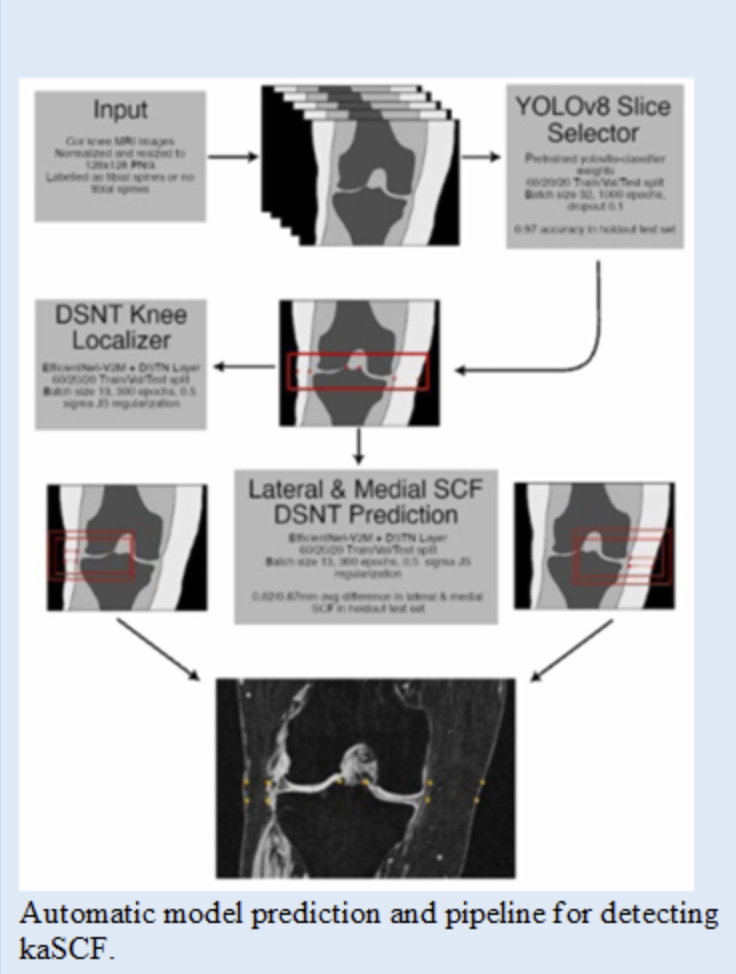
Knee-adjacent subcutaneous fat (kaSCF) has emerged as a potential biomarker and risk factor for osteoarthritis (OA) progression. We developed an artificial intelligence-based tool for the automatic segmentation of kaSCF thickness and evaluated the cross-sectional associations between kaSCF, cartilage thickness, magnetic resonance imaging-based cartilage T2 relaxation time, knee pain, and muscle strength independent of body mass index (BMI). We found that greater kaSCF was associated with thinner cartilage in men, higher T2 in women, reduced knee strength, and greater knee pain, independent of BMI. These findings suggest a potential role of kaSCF as a predictor for knee osteoarthritis-related structural, functional, and clinical outcomes independent of the effects of BMI.
Read more about this project:
Quantifying knee-adjacent subcutaneous fat in the entire OAI baseline dataset - Associations with cartilage MRI T2, thickness and pain, independent of BMI. Joseph GB, Liu F, Ziegeler K, Akkaya Z, Lynch JA, Pedoia V, Majumdar S, Lane NE, Nevitt MC, McCulloch CE, Link TM. Osteoarthritis Cartilage. 2025 Apr;33(4):482-490. doi: 10.1016/j.joca.2025.01.001. Epub 2025 Jan 27.