
High Field MRI Center
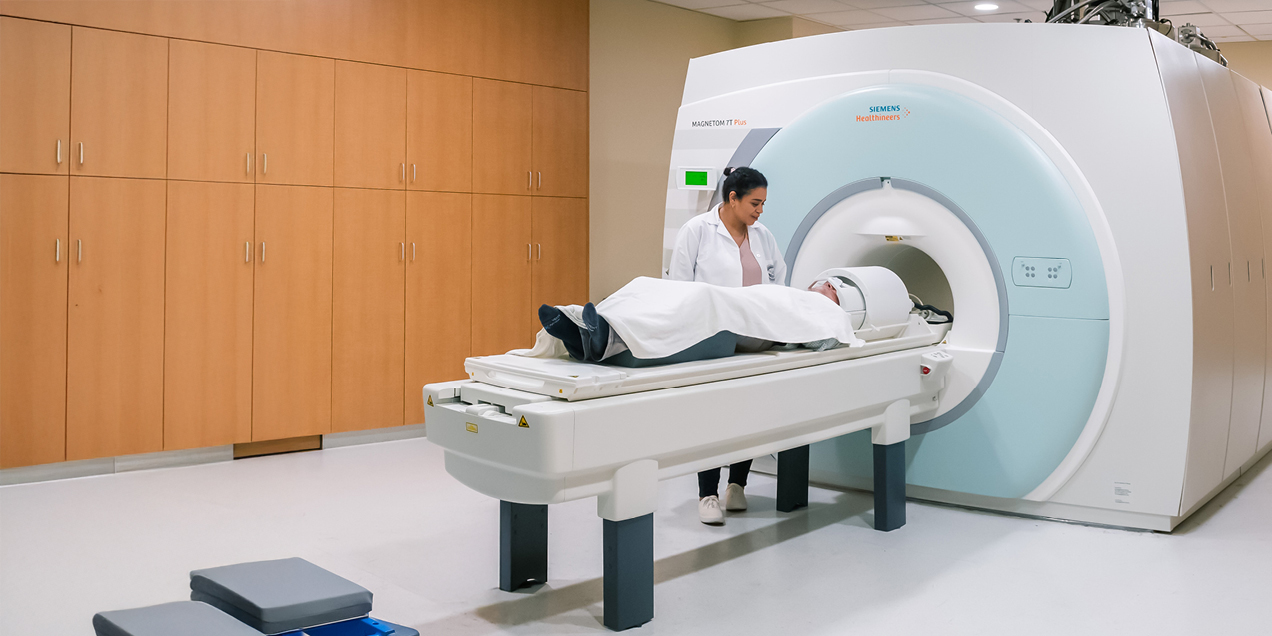
The High Field MRI Center supports advanced neuroimaging and physiological research using cutting-edge MRI systems operating at both 3T and 7T field strengths. Located within the VA Advanced Imaging Research Center (VAARC), the facility enables UCSF investigators and collaborators to pursue innovative studies in human brain structure, function, and physiology.
MRI Systems and Facilities
The VAARC houses state-of-the-art MRI systems dedicated to research. Equipment supports task-based and resting-state fMRI, as well as physiological recordings including EEG, ECG, and respiratory motion. Additional facilities include rooms for participant preparation, subject interviews, and setup for physiological monitoring during MRI sessions.
3 Tesla Siemens Skyra
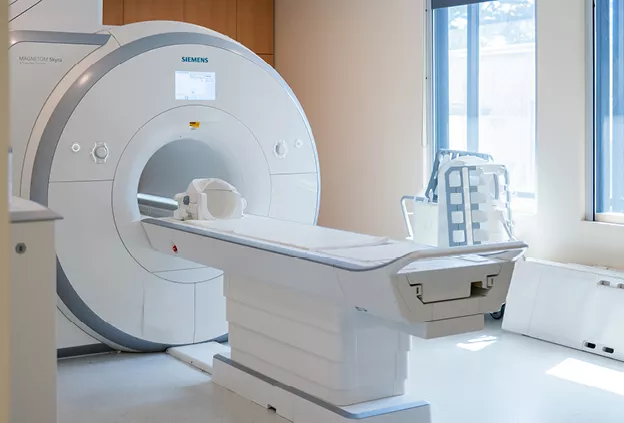
The 3T Magnetom Skyra is a research-dedicated MRI system with a 70 cm bore and high-performance gradients.
A Magnetom 3 Tesla Skyra MRI system is located within the Research MRI Suite in the basement of Building 203 and is fully dedicated to research scanning. The Skyra comes equipped with an actively-shielded 70cm bore magnet, an actively-shielded water-cooled gradient system, providing 45mT/m gradients with a slew rate of 200T/m/s, a digital RF transmit and a 64 channels receive system. The Skyra system includes packages for diffusion tensor imaging, 2D arterial spin labeling perfusion imaging, susceptibility-weighted imaging, BOLD rsfMRI, single voxel spectroscopy, 2D and 3D chemical shift imaging, and multinuclear spectroscopy. The system also comes with the following receiver coils:
- Multi-element Body Matrix
- 32 Channel Spin Matrix
- 20 Channel Head/Neck
- 32 Channel Head
- 36 Channel Peripheral Angio
- 4 Channel Large Flex
- 4 Channel Small Flex
- 16 Channel Hand/Wrist
- 16 Channel Shoulder – Large
- 16 Channel Should – Small
- 15 Channel Transmit/Receive Knee (QED)
Standard imaging protocols are available and specific advanced sequences can often be negotiated as a Works In Progress with our partners at Siemens, or through c2p research agreements with other institutions. One example is an optical motion tracking and correction package for brain MRI that is supported through a collaboration with the University of Freiburg, Germany. Prospective motion correction is now routinely available for high-resolution MPRAGE and TSE. The optical motion tracking device can further be used with the auxiliary equipment for fMRI. Also, the 3T system is capable of simultaneous EEG recording and MR imaging as well as task-based stimuli presentation for fMRI.
7 Tesla Siemens Magnetom
The 7T Magnetom is an ultra-high-field, research-dedicated MRI system with a 60 cm bore and high-performance gradients.
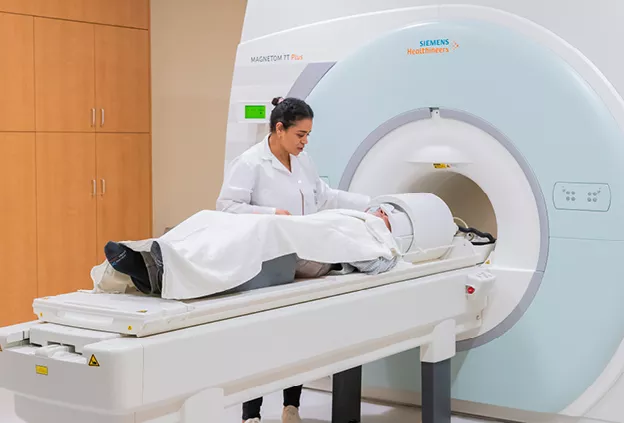
- The 7T Magnetom is also a fully dedicated research system. This ultra-high field MRI system, located in the Research MRI Suite, is equipped with a state-of-the-art actively-shielded whole body magnet with 60cm bore size, an actively-shielded water-cooled gradient system, providing up to 70mT/m gradients per axis with a maximum slew rate of 200 T/m/s.
- The system also includes a single channel transmit Nova Medical 32 channel receive head coil as well as a RF power amplifier providing up to 8 kW power. In addition, the 7T system includes a multinuclear MR package, as well as neurosoftware imaging packages and IDEA/ICE research development tools for sequence development.

MR Study Application
Investigators who wish to use the High Field MRI Center must submit a new MR Study Application before beginning any work. This includes all new studies, projects, or development efforts. Submitting the application starts a conversation with the support team to align on expectations and requirements. For funded studies, applications will be reviewed to determine scan time priority, and users will be notified once their application has been approved.
Request MR Study Application form.
MR User Certification
Official MR User certification is required for all personnel accessing the MRI Center as part of their research. The certification ensures safe operation of the MRI facilities, protecting volunteers, research staff, and personnel during daily scanner use. Because the High Field MRI Center is located on federal property, these safety guidelines are mandated by the VA and are intended to prevent accidents involving the MRI system. Per VA mandate, all certifications expire annually.
High Field Recharge Rates
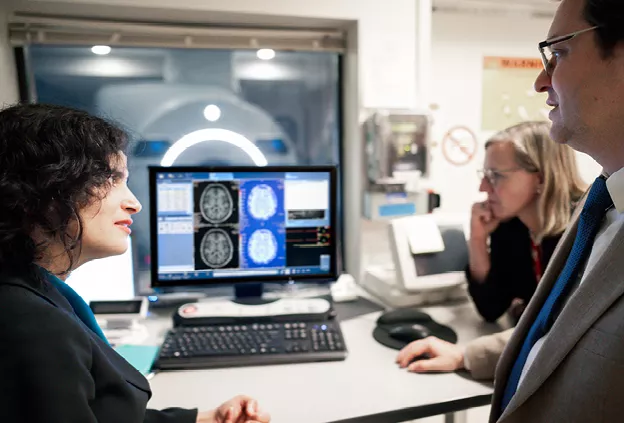
The High Field MRI Center updates its recharge rates every year on October 1. Rates cover 3T and 7T MRI scan time, technical support, user training, and required Level 1 personnel. Scan costs increase annually, while support services hold steady at the current hourly rate.
Recharge rates are updated annually on October 1.
| Service | Rate | Effective Date | Billing Interval |
|---|---|---|---|
| 3T/7T MR Scan/hr | $620 | Oct 1, 2023 | 0.5 hr |
| 3T/7T MR Scan/hr | $650 | Oct 1, 2024 | 0.5 hr |
| 3T/7T MR Scan/hr | $680 | Oct 1, 2025 | 0.5 hr |
| 3T/7T MR Scan/hr | $710 | Oct 1, 2026 | 0.5 hr |
| 3T/7T MR Scan/hr | $740 | Oct 1, 2027 | 0.5 hr |
| MR Tech/hr | $68 | Current | 1 hr |
| MR User Training/hr | $68 | Current | 1 hr |
| Attendance of Level 1 personnel (if required) | $68 | Current | 1 hr |
Safety
The High Field MRI Center follows a three-level safety certification system to make sure everyone in the MRI environment is trained and cleared appropriately. Level I covers basic personal safety and supervised access. Level II adds deeper safety knowledge and allows staff to handle basic MRI equipment and screen individuals for entry. Level III provides full access and authorizes independently operating the MRI system and related equipment. Each level issues its own user badge that must be worn at all times in the facility.
Level I certification provides the knowledge necessary to ensure one’s own safety during research-related activities within and around the MRI suite. Level I personnel may only have supervised access to the MRI suite and lack the authority to screen other individuals or bring other individuals into the scanner room. They may not enter the scan room without the approval of the scan operator (Level II or above). They are also prohibited from handling any MRI equipment. Certification at Level I requires training on how to screen oneself, what is and is not safe in the MRI environment, and knowledge of safety procedures for entering the MRI suite, and very basic emergency procedures (i.e. knowledge of who to call and how to rapidly access appropriate phone numbers).
When Level I Certification is complete, users will receive a yellow Level I User badge. This badge must be worn and displayed prominently at all times when present in the High Field MRI Center.
Level I users may include new staff trainees, recruiters, and schedulers.
Level II certification builds upon Level I certification, providing additional knowledge to protect the safety of others, and to safely handle basic MRI equipment. They are certified to operate the basic MR equipment (not including ancillary equipment), and also have knowledge to screen others for entry in the MRI suite. Level II users would also have more in-depth knowledge of MR safety issues, including the safety of different materials for the particular environment, the safety guidelines of the applicable IRBs, and where to get more information if needed. Level II personnel are permitted to escort volunteers into Zone IV (the magnet room). Level II personnel are not allowed to utilize or bring any ancillary equipment into Zone IV.
When Level II Certification is complete, users will receive a green Level II User badge. This badge must be worn and displayed prominently at all times.
Level II users may include scan operators and most personnel routinely involved in research activities at the MRI.
Level III certification builds upon Levels I and II certification, and provides additional knowledge necessary for complete independent operation of the MRI system. Level III personnel have access to all areas of the MRI suite, authorized ancillary equipment (such as fMRI screens, Motion Correction, etc.), and when operating the scanner, are responsible for the safety of all research personnel, volunteers, and visitors. These individuals would have knowledge of the requirements needed to run a safe MRI environment and the proper use of authorized ancillary MR equipment. Level III personnel are authorized to operate the MR scanner during off-hours.
When Level III Certification is complete, users will receive a blue Level III User badge. This badge must be worn and displayed prominently at all times.
Scheduling
This section explains how MRI scan time is booked and managed at the center. It covers how to schedule appointments, request development scans, handle cancellations, and coordinate shared or recurring time slots. Clear guidelines help ensure fair access and keep the scanner schedule running efficiently for everyone.
The High Field MRI Center utilizes an online scheduling system for investigators to reserve time on the 3T and 7T magnets. User logins are granted after a High Field MRI Center Study application has been submitted and approved.
MR Online Scheduling
All magnet appointments are assigned a priority level.
- Highest – Magnet Appointment, Billed (Orange): Billed Scanner Usage
- Magnet Training (Blue): Training
- Lowest – Magnet Development, Unbilled (Gray): Unfunded development
Each priority event is defined as follows:
Appointment, Billed (Orange)
Any usage of the magnet room, in which use of the magnet by another group is prevented. Includes setup in the magnet room. All appointments and time booked in orange will be billed. Highest priority. May bump blue or gray.
Training (Blue)
Training of any staff or on any new equipment. Includes all safety training and alike. Also includes pilot studies with recruited non-staff subjects. Each PI is allotted up to 10 pilot scans (for each new study) to collect preliminary data using a finalized study protocol. Medium priority. May be bumped by orange.
Development, Unbilled (Gray)
Any unfunded or unpaid development (i.e. protocol development). Also includes setup in console room, usage of console only, etc. Lowest priority. May be bumped by orange or blue.
Regardless of event type, all users are required to log the total time spent using the MRI scanner and study information in the Magnet Billing database.
Failure to log scans in the Magnet Billing database may result in a penalty charge of up to 2 hours of usage.
All MRI users may schedule scans during Open MRI slots. Unlike assigned MRI appointment slots, any user may utilize open magnet slots.
All scheduled MRI training or development scans may be bumped for funded research and clinical scans with participants (orange priority). If you are taking a slot in which there is already a scheduled appointment, you are required to notify the owner of the appointment you are bumping with as much notice as possible.
Users do not own any slots. If an MRI appointment with an outside participant has yet to be scheduled one week prior to the event, the slot then becomes available to all users on a first-come, first-served basis (One-Week Rule).
Users with assigned MRI slots must make every effort to schedule appointments during their assigned slots before using an open slot. Assigned slots may be requested in the CIND MR Application. All slots expire after six months and can be renewed by contacting CIND staff.
- During business hours (9:00 am – 5:00 pm): Unfunded scans must follow the One-Week Rule and may only be scheduled up to one week in advance.
- During off hours (before 9:00 am or after 5:00 pm): Unfunded scans may be scheduled in advance with no limitations.
In the event a booking is no longer needed, appointments must be removed from the calendar at least 48 hours before the event. Users who fail to do so may be charged the full amount of the booked time and risk losing scanning privileges.
If a center technician is utilized, notify the center Magnet Lead immediately when canceling. Do not include subject identifiers in email communication. Failure to notify CIND prior to the scheduled appointment may result in charges for unused scanner and technician time.
Recurring MRI appointment slots are assigned to funded studies based on recruitment totals. For example, a study aiming for 50 scans per year may receive a weekly slot. Time allocation also considers scan length and setup needs such as consenting, pre-screening, and EEG setup. All assigned slots are reviewed every six months.
To apply for an assigned slot, indicate it on the MR Study Application.
Users are encouraged to contact each other directly to request slot trades or shared use. Slot expiration dates remain unchanged.
If using a center technician and an MRI scan is scheduled within three days or less, notify the center Magnet Lead to confirm availability before scheduling.
Contact Us

High Field MRI Center
Stephanie Rossi
CIND Imaging Core Supervisor
Ph: (415) 221-4810 ext. 26387
Fax: (415) 379-5648
stephanie.rossi@ucsf.edu
SF Veterans Affairs Medical Center
4150 Clement Street, Bldg. 203, Basement
San Francisco, CA 94121