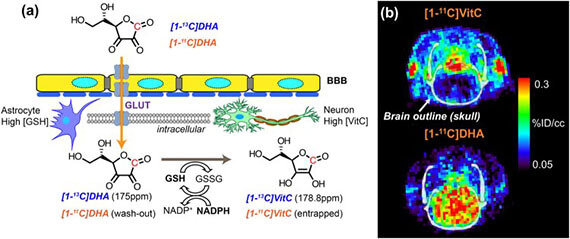
The redox status of cancer cells is critical in understanding both tumor aggressiveness and response to therapy. In cancer, dysregulation of reactive oxygen species (ROS) is linked to both enhanced tumorgenicity and resistance to common treatments in particular radiotherapy. We are developing new probes for clinically translatable imaging modalities, namely hyperpolarized (HP) 13C MR spectroscopy and positron emission tomography (PET), to study both abundant antioxidant molecules and reactive oxygen species including H2O2. Endogenous reduced glutathione (GSH) concentrations have been explored using hyperpolarized 13C dehydroascorbic acid as a redox sensor. A reaction-based method was employed to study extracellular H2O2 using a boronate-caged prodrug of 18F-FLT. We continue to pursue strategies to study relevant small-molecule analytes in cancer using both endogenous molecules and new chemical strategies.