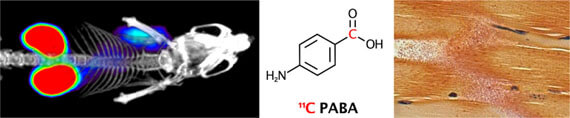
The Wilson laboratory is pursuing clinically translatable biomarkers for infection, particularly discitis-osteomyelitis, which may be difficult to diagnose using computed tomography (CT) and magnetic resonance imaging (MRI). Existing clinical strategies to image bacterial infection in patients rely on activated immune cells (either 111In white blood-cell scan or 18F-FDG) and thus cannot reliably distinguish living bacteria from sterile inflammation. We are studying translational biomarkers for hyperpolarized 13C spectroscopy and positron emission tomography (PET) that target metabolic pathways specific to bacteria. We have developed several agents with excellent clinical promise including D-amino acid derived tracers (collaborative work with co-PI’s Michael Ohliger and Oren Rosenberg). More recently we have developed imaging tools to detect the suppression of ACE2, the primary receptor for SARS-CoV-2 entry, in COVID-19.