
BACPAC: Preventing and Treating Low Back Pain and Disability
Chronic low back pain is a leading cause of disability in the United States, affecting 1 in 5 adults. Pain sources are nonspecific in almost two thirds of cases, making it difficult for doctors and patients to come up with effective treatment strategies. This lack of effective treatments strategies has led increasing treatment costs to patients and use of opioids to manage pain. Magnetic resonance imaging (MRI) is an effective technique for three-dimensionally imaging the lumbar spine, but imaging findings are notoriously ambiguous indicators due to their lack of consistent associations with clinical symptoms. National Institute of Health’s Back Pain Consortium Research Program (BACPAC) aims to develop our scientific understanding of the driving causes of chronic low back pain, so that we can create better, curative, individualized treatment strategies for patients and reduce opioid use.
At UCSF ci2, we are contributing to the consortium by collecting and analyzing MR images of people with chronic low back pain to learn how we can use quantitative image-based findings to learn about and treat clinical symptoms. We also build tools to automate quantitative image analysis for clinical use to improve routine patient care and outcomes, including automatic bone, disc and muscle segmentation and characterization. We have trained deep learning-based models to detect anomalies like modic changes, stenotic narrowing in the central spinal canal, vertebral body fractures, and intervertebral disc compressions from MRI. These models have been demonstrated as useful assistants in educating and improving performance in trainees. Scaling these models has helped both our researchers and our collaborators identify new findings and associations between quantitative image-based metrics and chronic low back pain by enhancing dataset size. To put these findings into practice, we deployed those models inline with image acquisition for testing in real time. We hope to translate this work to the clinic and someday empower treating physicians can with AI-assisted data enrichment to develop more effective, individualized interventions to help patients stay happier and healthier.
Related Publications
- Bharadwaj, Upasana Upadhyay, Miranda Christine, Steven Li, Dean Chou, Valentina Pedoia, Thomas M. Link, Cynthia T. Chin, and Sharmila Majumdar. “Deep Learning for Automated, Interpretable Classification of Lumbar Spinal Stenosis and Facet Arthropathy from Axial MRI.” European Radiology 33, no. 5 (May 1, 2023): 3435–43. https://doi.org/10.1007/s00330-023-09483-6.
- Gao, Kenneth T., Radhika Tibrewala, Madeline Hess, Upasana U. Bharadwaj, Gaurav Inamdar, Thomas M. Link, Cynthia T. Chin, Valentina Pedoia, and Sharmila Majumdar. “Automatic Detection and Voxel-Wise Mapping of Lumbar Spine Modic Changes with Deep Learning.” JOR SPINE 5, no. 2 (2022): e1204. https://doi.org/10.1002/jsp2.1204.
- Han, Misung, Emma Bahroos, Madeline E Hess, Cynthia T Chin, Kenneth T Gao, David D Shin, Javier E Villanueva-Meyer, Thomas M Link, Valentina Pedoia, and Sharmila Majumdar. “Technology and Tool Development for BACPAC: Qualitative and Quantitative Analysis of Accelerated Lumbar Spine MRI with Deep-Learning Based Image Reconstruction at 3T.” Pain Medicine 24, no. Supplement_1 (August 1, 2023): S149–59. https://doi.org/10.1093/pm/pnad035.
- Hess, Madeline, Brett Allaire, Kenneth T Gao, Radhika Tibrewala, Gaurav Inamdar, Upasana Bharadwaj, Cynthia Chin, et al. “Deep Learning for Multi-Tissue Segmentation and Fully Automatic Personalized Biomechanical Models from BACPAC Clinical Lumbar Spine MRI.” Pain Medicine 24, no. Supplement_1 (August 1, 2023): S139–48. https://doi.org/10.1093/pm/pnac142.
Project members at UCSF
Sharmila Majumdar, Misung Han, Felix Liu, Christine Park, Eugene Ozhinsky, Michelle Tong, Jennifer Cummings, Isabelle Remick, Emma Bahroos, Madeline Hess, Cynthia Chin, Mark Choe, Upasana Bharadwaj, Valentina Pedoia, Kenneth Gao
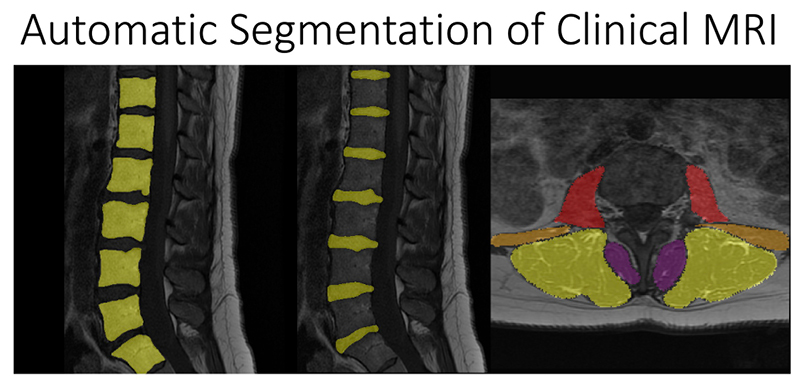
Automatic Segmentation of Clinical MRI
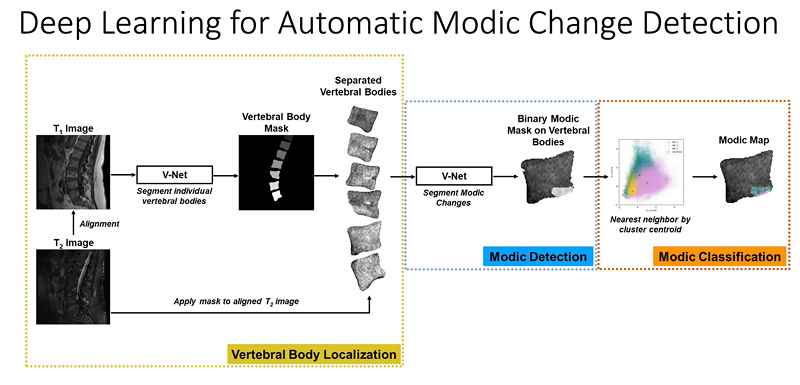
Deep Learning for Automatic Modic Change Detection
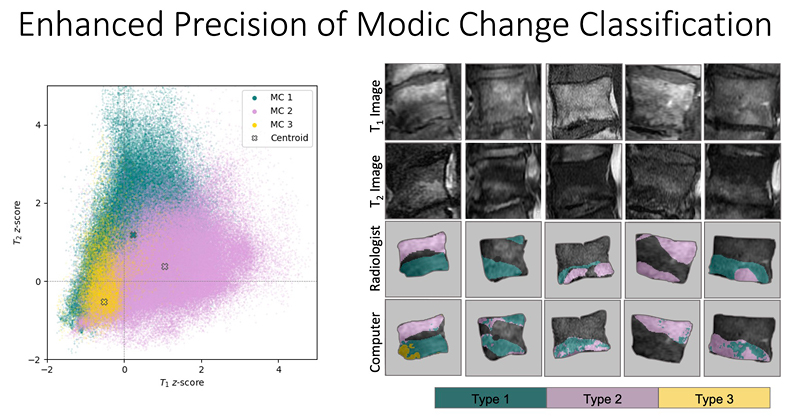
Enhanced Precision of Modic Change Classification
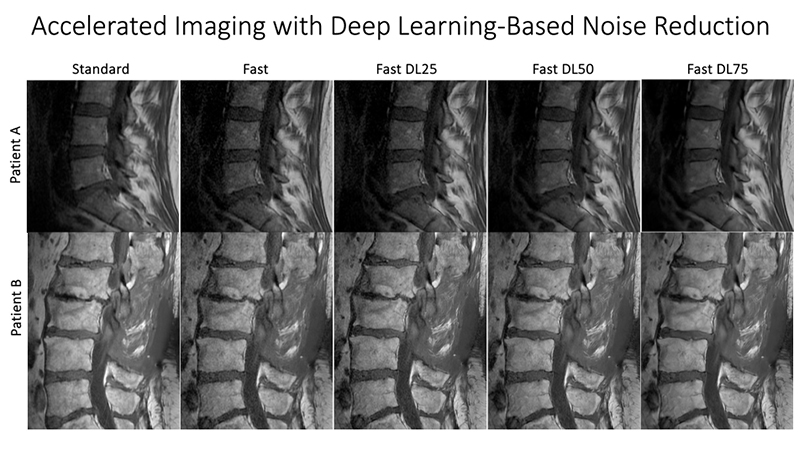
Accelerated imaging with Deep Learning-Based Noise Reduction
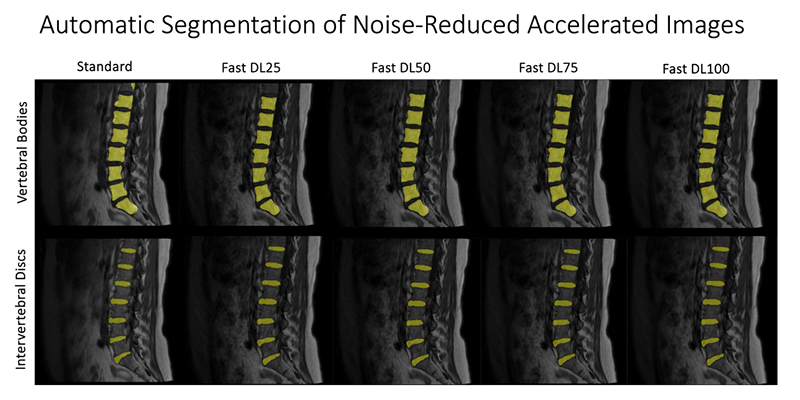
Automatic Segmentation of Noise-Reduced Accelerated Images
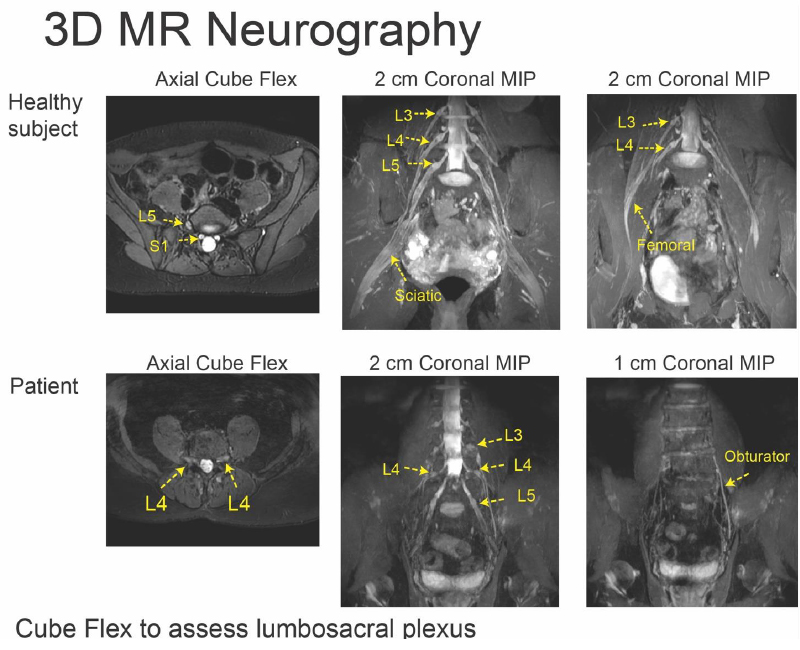
3D MR Neurography