
Generating Synthetic T1ρ Maps from T2 Maps for Knee MRI with Deep Learning
A 2D U-Net was trained to generate synthetic T1rho maps from T2 maps for knee MRI to explore the feasibility of domain adaptation to enrich existing datasets or for faster image reconstruction. The network was developed using images from two prior research studies across three institutions. Network generalizability was evaluated on two new datasets acquired as part of the standard-of-care acquired in a clinical setting and from simultaneous bilateral acquisition in a research setting. This study found the network performed excellent reconstruction of T1rho maps preserving textures and local T1rho elevation patterns in cartilage with NMSE of 2.4% and Pearson’s correlation coefficient of 0.93. Decreased performance for external datasets may be attributed to slight variation in acquisition from different MR scanners and knee coils, suggesting deep learning networks would benefit from volume-wise consideration of scanner properties for performance agnostic to MR scanner equipment.
Project members at UCSF
Michelle Tong, Aniket Tolpadi, Rupsa Bhattacharjee, Misung Han, Sharmila Majumdar, Valentina Pedoia
Funding number
AF-ACL consortium; NIH UH3AR076724; and NIH R01AR078762
Project period
Sept 2021- Oct 2022
Principal Investigator
Valentina Pedoia
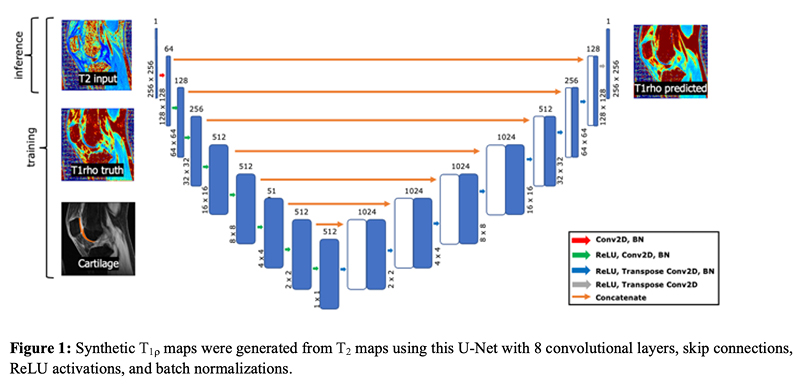
Figure 1: Synthetic T1ρ maps were generated from T2 maps using the U-Net with 8 convolutional layers, skip connections, ReLU activations, and batch normalizations.
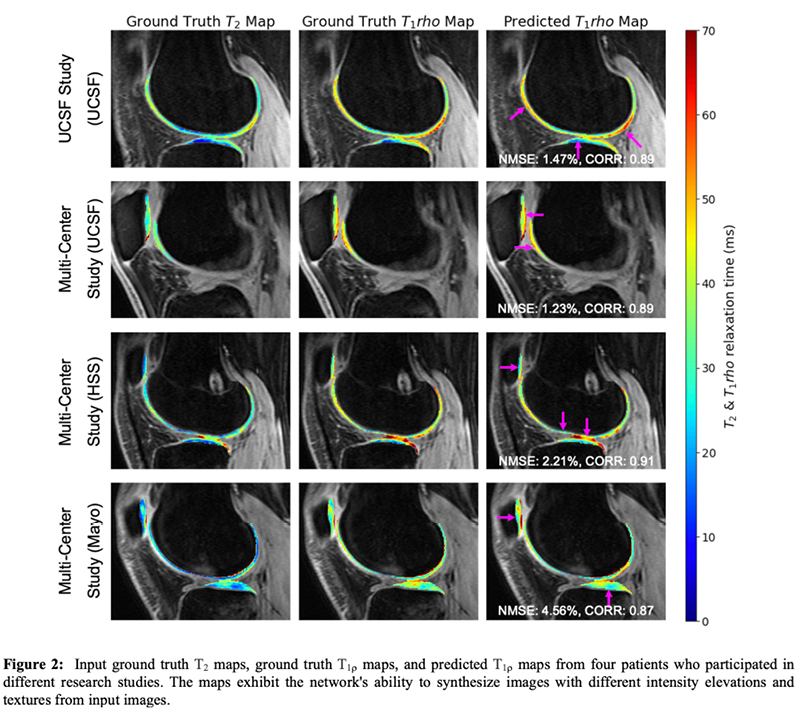
Figure 2: Input ground truth T2 maps, ground truth T1ρ maps, and predicted T1p maps from four patients who participated in different research studies. The map exhibit the network's ability to synthesis images with different intensity elevations and textures from input images.