Osteoarthritis Initiative (OAI) Project Overview
This extensive body of work is propelled by data-driven methodologies to advance our understanding of osteoarthritis (OA) and its implications for patient outcomes and disease progression. It encompasses various aspects, including disease trajectory analysis, tool development, and prediction techniques, all founded on the extraction of imaging biomarkers through automated deep learning segmentation pipelines. The research aims to inform our understanding of OA through these multifaceted efforts, paving the way for improved patient care within musculoskeletal imaging. This comprehensive approach may encompass diagnosis, prediction, targeted prevention, and personalized treatment strategies, collectively underscoring the transformative potential of data-driven approaches to reshape our comprehension of OA and enhance patient care in the future.
qMRI 100-D Interpretable Feature Space of Knee Osteoarthritis: A Digital Twin Analysis
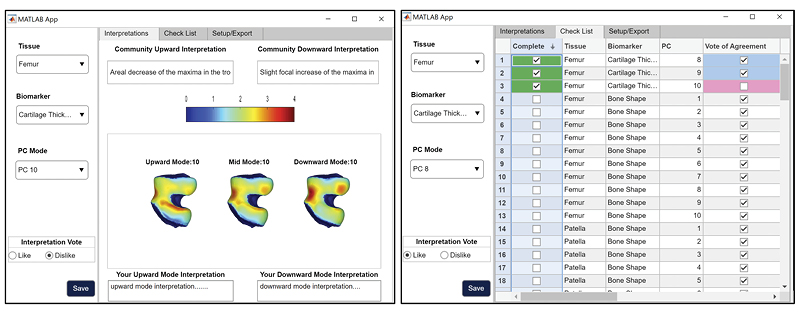
This multifaceted study, conducted on the Osteoarthritis Initiative (OAI) dataset, represents a significant advancement within the field of musculoskeletal imaging. It encompasses a comprehensive exploration of knee structures, including the femur, patella, tibia, and menisci, while examining a diverse array of imaging biomarkers, such as cartilage thickness, cartilage T2, bone shape, and meniscus shape. Employing cutting-edge techniques like automatic statistical shape modeling and deep learning segmentation pipelines, the study establishes a 100-D interpretable feature space of biomarker-tissue Principal Component (PC) modes. Furthermore, it integrates Digital Twin Analysis, including Image Twin and Clinical Twin analyses, to unveil the intricate relationships between morphological variations and clinical metadata in the context of osteoarthritis (OA) incidence. Through this multidimensional approach, the study provides valuable insights into factors influencing OA development and offers a promising avenue for improving patient care and furthering our understanding of musculoskeletal health.
Related code
https://github.com/gabbieHoyer/OAI-PC-mode-interpreter
Related publications
- Pedoia, Valentina, et al. "Three-Dimensional MRI-Based Statistical Shape Model and Application to a Cohort of Knees with Acute ACL Injury." Osteoarthritis and Cartilage / OARS, Osteoarthritis Research Society, vol. 23, no. 10, 2015, p. 1695, https://doi.org/10.1016/j.joca.2015.05.027.
- Pedoia, V et al. “Diagnosing osteoarthritis from T2 maps using deep learning: an analysis of the entire Osteoarthritis Initiative baseline cohort.” Osteoarthritis and cartilage vol. 27,7 (2019): 1002-1010. doi:10.1016/j.joca.2019.02.800
- Morales Martinez, Alejandro et al. “Learning osteoarthritis imaging biomarkers from bone surface spherical encoding.” Magnetic resonance in medicine vol. 84,4 (2020): 2190-2203. doi:10.1002/mrm.28251
- Iriondo, Claudia et al. “Towards understanding mechanistic subgroups of osteoarthritis: 8-year cartilage thickness trajectory analysis.” Journal of orthopaedic research: official publication of the Orthopaedic Research Society vol. 39,6 (2021): 1305-1317. doi:10.1002/jor.24849
- Morales, Alejandro G et al. “Uncovering associations between data-driven learned qMRI biomarkers and chronic pain.” Scientific reports vol. 11,1 21989. 9 Nov. 2021, doi:10.1038/s41598-021-01111-x
- Xie, E., et al. "Statistical Shape Modeling of the Meniscus from the Osteoarthritis Initiative – A Large-Scale, Data-Driven Evaluation of Demographics and Correlation to Osteoarthritis Incidence." Osteoarthritis and Cartilage, vol. 30, 2022, pp. S276-S277, https://doi.org/10.1016/j.joca.2022.02.373.
- Cummings, Jennifer, et al. "The Knee Connectome: A Novel Tool for Studying Spatiotemporal Change in Cartilage Thickness." Journal of Orthopaedic Research®, https://doi.org/10.1002/jor.25637.
- Gao, Kenneth T., et al. "Large-Scale Analysis of Meniscus Morphology As Risk Factor for Knee Osteoarthritis." Arthritis & Rheumatology, https://doi.org/10.1002/art.42623.
- Hoyer G et al. Quantitative MRI Interpretable 100D Feature Space of Knee Osteoarthritis. In Proceedings of the 31st Annual Meeting of ISMRM, Toronto, Ontario, Canada, 2023. 993.
Project members at UCSF
Gabrielle Hoyer, Jennifer Cummings, Upasana Bharadwaj, Zehra Akkaya, Valentina Pedoia, Sharmila Majumdar
Funding number
Supported by the National Institute of Arthritis and Musculoskeletal and Skin Diseases (NIAMS), NIH (grant R00-AR-070902).
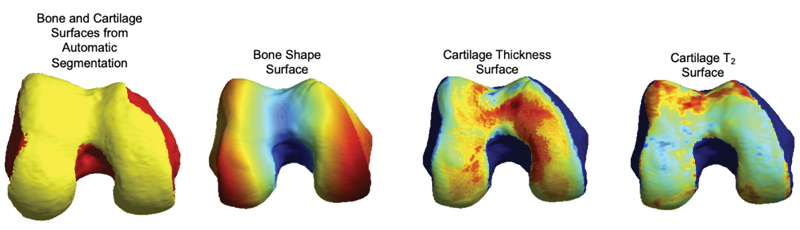
Bone and Cartilage Surface from Automatic Segmenation, Bone Shape Surface, Cartilage Thickness Surface, Cartilage T2 Surface