
Lupo Lab
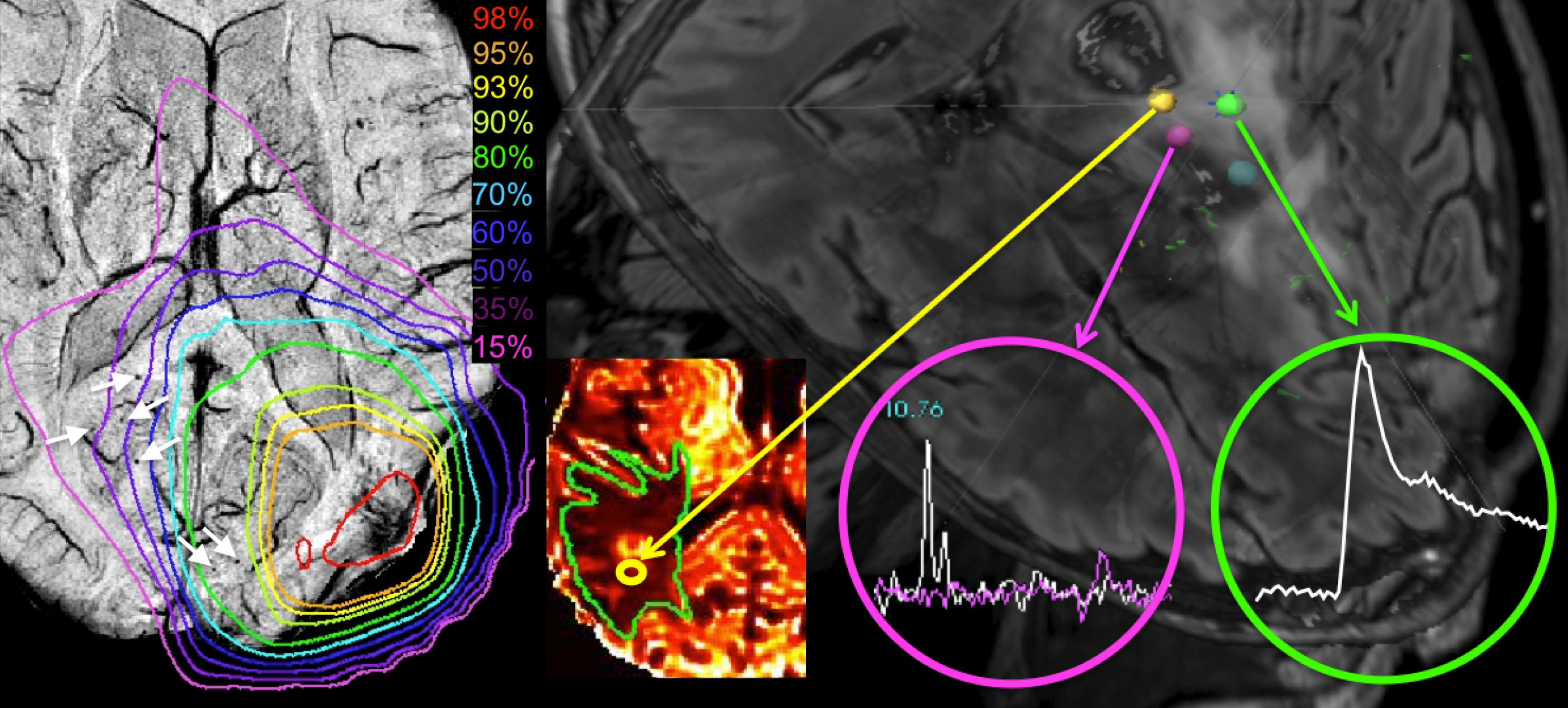
Our group is focused on developing novel methods for acquisition, reconstruction, post-processing, and quantitative analysis of Magnetic Resonance (MR) brain images. Using a combination of multiparametric structural, physiological, and metabolic MRI techniques, our goal is to quantitatively characterize heterogeneity within malignant brain tumors, monitor response to novel treatment regimens, and investigate the long-term effects of therapy on healthy brain tissue structure and cognitive function. As part of the Surbeck Laboratory for Advanced Imaging, we are based in Byers Hall at the UCSF Mission Bay campus and have access to state-of-the-art 3T and 7T human research scanners. Many of the methodologies we develop initially to evaluate patients with brain tumors are also being applied to other neurological diseases.
Publications
Lab Members




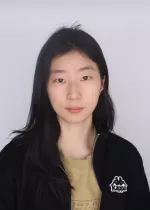

- Melanie Morrison, PhD, focused on the use of ultra-high field MRI (7T) to better understand the long-term effects of radiotherapy on the developing brain. She used different MRI techniques, image processing and statistical methods to evaluiate the relationship between at radiotherapy-induced vascular changes, brain connectivity, and neurocognitive function.
- Julia Cluceru, PhD, worked on using multi-parametric approaches to understand differences between glioma recurrence and pseudoprogression & treatment necrosis.
- Sivakami Avadiappan, worked on acquisition, processing and interpretation of vascular MR images from brain tumor survivors post radiation therapy.
- Maryam Vareth designed and developed techniques for acquisition, reconstruction, post-processing and quantitative analysis of multi-channel, phased array detectors for high field Magnetic Resonance Spectroscopy imaging (MRSI) with the goal of improving the sensitivity and specificity of the data obtained for characterizing human disease.
- James Golden, PhD, interests include both the application and theory of deep learning. James built deep networks for the detection of cerebral microbleeds and symptom onset in Huntington's disease.
- Yicheng (Eason) Chen, former PhD candidate. Eason focused on applying quantitative susceptibility mapping (QSM) to dieases related to brain iron deposition. He was also interested in incorporating deep learning techniques into medical imaging.
- Guanzhong Su was a graduate student in the Master of Science in Biomedical Imaging (MSBI) program at UCSF. His research was focused on developing a pipeline for integration of metabolic and physiology imaging into clinical workflow for radiation treatment planning for glioblastoma (GBM) patients.
- Justin P. Yuan was an Assistant Specialist. His research interests were in the usage of MRI to characterize adolescent brain changes and the reliability of such measures.
- Xiaowei Zou, PhD, former post doctoral scholar who worked with Dr. Lupo from 2014-2016 on image acquisition, reconstruction, and post-processing algorithms for the detection and quantification of cerebral microbleeds.
- Prasanna Parvathaneni, MSc, worked on incorporating distortion correction of EPI images into our perfusion image processing pipeline, implementing a faster tool for NODDI modeling of diffusion imaging data and relating derived metrics to histopathology.
- Shauna O’Donnell previously worked as Clinical Research Coordinator.
- Brendan Mitchell, was a rotation student, studying the progression of Huntington's disease using multi-modal MRI.
- Paul Rowley was a Clinical Research Coordinator. Born in San Francisco and raised in Madison, Wisconsin, Paul joined the Lupo Lab in 2017 while studying medicine at the University of Wisconsin School of Medicine and Public Health (class of 2022). His research interests included applying diffusion tensor imaging (DTI) and quantitive susceptibility mapping (QSM) to study Huntington’s disease; developing and comparing QSM reconstruction methodologies; and using multiparametric imaging to improve radiotherapy planning for patients with glioblastoma multiforme.
- Tiffany Ngan was a Staff Research Associate 2.
- Ozan Genc was an Assistant Specialist. Ozan was interested in applying both classical machine learning and deep learning techniques to medical image data. In his previous research, he focused on dimensionality reduction techniques to find possible MRI biomarkers identifying Mild Cognitive Impairment in Parkinson’s disease. In the Lupo Lab, he worked on synthesizing MR images using deep convolutional neural networks. Ozan completed his MSc in Biomedical Engineering at Bogazici University, Istanbul after earning his BSc in Electrical & Electronics Engineering.
Contact Us

Lupo Lab
Jasmine Parayaoan Tengsico
Administrative Contact
jasmineparayaoan.tengsico@ucsf.edu
Mission Bay Campus
Byers Hall 1700 4th Street
Room 303, MC 2532
San Francisco, CA 94158-2330